In the relentless pursuit of manufacturing excellence, unplanned downtime is the ultimate adversary. It strikes without warning, halts production lines, triggers costly emergency repairs, and derails delivery schedules. For decades, manufacturers have relied on reactive maintenance (fixing things when they break) or preventive maintenance (scheduling fixes at set intervals). While better than pure reactivity, preventive maintenance is inherently flawed—it often leads to replacing parts that still have life, wasting resources, and still failing to catch unexpected failures.
But a new industrial revolution is silencing the alarms of unexpected breakdowns. The convergence of the Industrial Internet of Things (IIoT) and Artificial Intelligence (AI) is ushering in an era of predictive maintenance, a transformative approach that is proactively cutting unplanned downtime by 50% or more in forward-thinking smart factories.
From Scheduled to Smart: The Evolution of Maintenance
To appreciate the seismic shift, it’s essential to understand the journey:
- Reactive Maintenance: The “run-to-failure” model. It’s inexpensive in the short term but catastrophically expensive when a critical asset fails, causing cascading production delays.
- Preventive Maintenance: Time or usage-based scheduling. This reduces unexpected failures but is inefficient. It’s like changing your car’s oil every 3,000 miles regardless of how you drove—sometimes it’s necessary, often it’s wasteful.
- Predictive Maintenance (PdM): The condition-based approach. Sensors monitor equipment in real-time, allowing maintenance to be performed precisely when needed—no sooner, no later.
- Prescriptive Maintenance: The evolution of PdM. AI doesn’t just predict a failure; it diagnoses the root cause and prescribes the optimal corrective action, often before a human operator can even identify the problem.
This leap to predictive maintenance manufacturing is powered by the symbiotic relationship between IIoT and AI.
The Engine Room: How IIoT Predictive Maintenance Works
The system functions like a central nervous system for your factory floor. Here’s how it works in practice:
- Data Acquisition (The Senses):
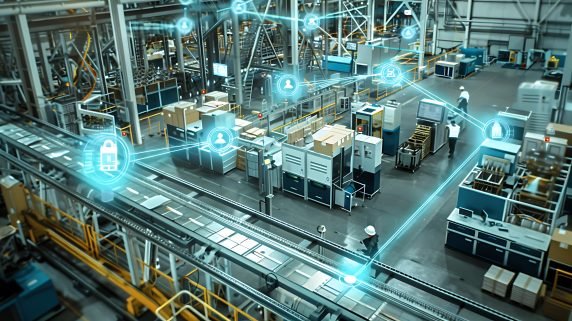
A network of IIoT sensors—vibration, acoustic, temperature, pressure, current, and ultrasonic—is attached to critical assets like CNC machines, pumps, conveyors, and robots. These sensors act as digital senses, continuously collecting high-fidelity data on the equipment’s health and performance. - Data Transmission & Aggregation (The Nervous System):
The raw sensor data is securely transmitted via IIoT gateways to a centralized cloud or edge computing platform. This creates a unified, massive data lake of historical and real-time operational information. - AI-Powered Analytics (The Brain):
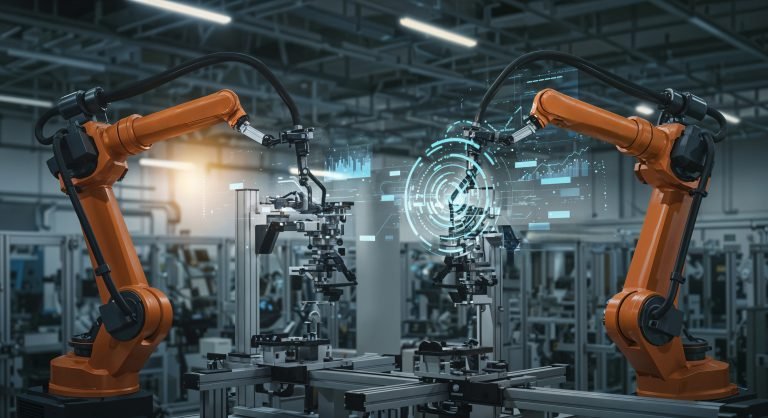
This is where the magic happens. This is not mere data logging. Sophisticated AI and machine learning algorithms analyze the vast, complex datasets. They learn the unique “digital fingerprint” or baseline of normal operation for every piece of equipment. Then, they continuously look for subtle anomalies and patterns that human analysis would inevitably miss.
- Machine Learning Models detect deviations from baselines.
- Pattern Recognition identifies trends indicative of wear and tear, like increasing vibration frequencies.
- Root Cause Analysis pinpoints why a failure might occur, moving beyond the symptom to the source.
- Actionable Insights (The Output):
The AI translates its analysis into clear, actionable insights delivered via dashboards, alerts, and maintenance work orders to plant managers and technicians. Instead of a generic “check motor 5B,” the alert might read: “Predictive maintenance IoT alert:Motor 5B showing early signs of inner race bearing fault. Vibration levels predicted to exceed threshold in 12±3 days. Schedule maintenance before August 25th.” This precision is what slashes unplanned downtime.
The Tangible Benefits: More Than Just Avoiding Breakdowns
Reducing unplanned downtime by 50% is a headline-worthy achievement, but the benefits of an AI-driven IIoT predictive maintenance strategy ripple across the entire operation:
- Dramatically Lower Maintenance Costs: Move from costly emergency repairs and unnecessary scheduled parts changes to precisely timed, efficient interventions. This extends the Mean Time Between Failures (MTBF) and optimizes spare part inventory.
- Enhanced Productivity & OEE: Continuous, predictable production lines maximize Overall Equipment Effectiveness (OEE). With fewer interruptions, throughput increases significantly.
- Improved Safety & Risk Mitigation: Catastrophic failures can be dangerous. Predicting and preventing them creates a safer work environment and reduces associated environmental and safety risks.
- Extended Asset Lifespan: By addressing issues at their earliest stage, stress on machinery is minimized, effectively extending the useful life of capital-intensive assets.
- Data-Driven Decision Making: Shift from gut-feel decisions to strategic, data-backed capital planning. Understand which assets are most critical and prone to failure, informing future investment strategies.
Implementing Your Predictive Journey: Key Considerations
Transitioning to a predictive model requires careful planning:
- Start with Critical Assets: Begin with high-value, failure-prone equipment where downtime has the greatest financial impact. This demonstrates quick ROI and builds organizational buy-in.
- Ensure Robust Connectivity: A strong and secure IIoT network is the backbone. Evaluate edge computing to process data closer to the source for low-latency responses.
- Focus on Data Quality: AI models are only as good as the data they train on. Clean, relevant, and well-labeled data is non-negotiable.
- Build a Culture of Adoption: Technology is only half the battle. Train your maintenance teams to trust and act on the AI’s recommendations. This is a shift from a reactive to a proactive mindset.
The Future is Predictive, The Time is Now
The potential of AI-driven IIoT predictive maintenance is clear, but successful implementation requires expert guidance and a tailored strategy. At ARi, we are at the forefront of the digital industrial transformation. Our deep domain expertise in engineering and manufacturing, combined with our cutting-edge capabilities in AI and IIoT integration, allows us to design and deploy bespoke predictive maintenance solutions that deliver measurable, bottom-line results.
We don’t just provide technology; we provide a partnership. Our team will work with you to identify your highest-value opportunities, integrate seamlessly with your existing systems, and empower your team to harness the full power of your data.
Stop reacting to failures. Start predicting them. Contact ARi today to schedule a consultation and discover how our predictive maintenance solutions can future-proof your operations and drive your productivity to new heights.